
Divorce, separation, or remarriage can break the family you've built. But in that pain, your loved ones' futures are often left unprotected by the law. Picture your kids or new family shocked by the unfair shares, fighting over the property you bought yourself, or even losing everything due to changes in marriage.
In this article, we have covered rights in case of both Male & Female under different personal laws.
HINDU LAW(Governed by the Hindu Succession Act and the Hindu Marriage Act)
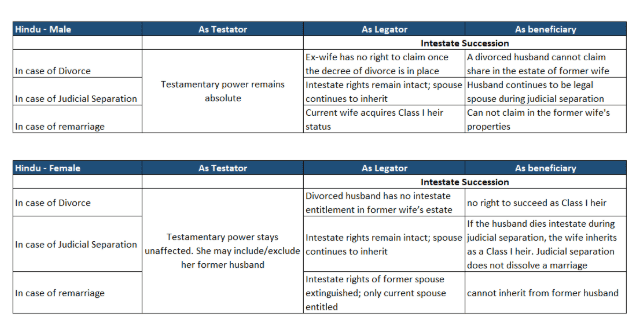
In the case of a Male
1A. Divorce
1A.1 As Testator (Testamentary succession)
A Hindu male enjoys unrestricted testamentary freedom.
Divorce does not restrict his capacity to execute a will.
He may include or exclude his former wife at his discretion.
1A.2 As Legator (intestate succession)
Ex-wife has no right to claim once the decree of divorce is in place
1A.3 As Beneficiary (Intestate Succession)
Under Sections 15 and 16 of the Hindu Succession Act, the husband is an heir to a Hindu female dying intestate.
The husband’s right depends upon a lawful subsisting marriage.
After the decree of divorce, he ceases to be “husband” in the statutory sense.
Therefore, a divorced husband cannot claim a share in the estate of former wife.
1B. Judicial Separation
1B.1 As Testator (Testamentary succession)
Testamentary power remains absolute.
1B.2 As Legator (intestate succession)
Intestate rights remain intact; the spouse continues to inherit.
1B.3 As Beneficiary (Intestate Succession)
Husband continues to be legal spouse during judicial separation.
If the wife dies intestate, he inherits according to statutory order.
1C. Remarriage
1C.1 As Testator (Testamentary succession)
Remarriage does not affect testamentary competence
1C.2 As Legator (intestate succession)
If divorce has been granted, remarriage confirms the extinction of the former marital status. The former wife can not claim rights.
1C.3 As Beneficiary (Intestate Succession)
Upon remarriage after divorce, the former wife is excluded from succession.
New wife acquires Class I heir status
In the case of a Female
1A. Divorce
1A.1 As Testator (Testamentary succession)
Under the Hindu Succession Act, the widow is a Class I heir.
The right of a woman to inherit as a widow is dependent upon a subsisting marriage at the time of the husband’s death.
A decree of divorce under the Hindu Marriage Act dissolves the marriage completely.
Upon dissolution, the woman ceases to answer the description of “widow.”
Therefore, if the husband dies intestate after divorce, the divorced woman has no right to succeed as Class I heir.
If death occurs before the decree of divorce, the wife inherits as a widow.
In case of a void marriage declared null, no right of inheritance arises.
In a voidable marriage, rights continue until annulled.
1A.2 As Legator (intestate succession)
Ex-husband has no right to claim once the decree of divorce is in place
1A.3 As Beneficiary (Intestate Succession)
Under Sections 15 and 16 of the Hindu Succession Act, the husband is an heir to a Hindu female dying intestate.
The husband’s right depends upon a lawful subsisting marriage.
After the decree of divorce, he ceases to be “husband” in the statutory sense.
Therefore, a divorced husband cannot claim a share in the estate of former wife.
1B. Judicial Separation
1B.1 As Testator (Testamentary succession)
Testamentary power unaffected.
She may exclude her husband from her will.
1B.2 As Legator (intestate succession)
Intestate rights remain intact; the spouse continues to inherit.
1B.3 As Beneficiary (Intestate Succession)
Judicial separation does not dissolve marriage.
The status of a wife continues in law.
If the husband dies intestate during judicial separation, the wife inherits as a Class I heir.
The suspension of cohabitation does not extinguish inheritance rights
1C. Remarriage
1C.1 As Testator (Testamentary succession)
Remarriage does not affect testamentary competence
1C.2 As Legator (intestate succession)
If divorce has been granted, remarriage confirms the extinction of the former marital status. The former wife can not claim rights.
1C.3 As Beneficiary (Intestate Succession)
If divorce has been granted, remarriage confirms the extinction of the former marital status.
She cannot inherit from her former husband.
If she remarries after her husband’s death and the property has vested, such remarriage does not divest the vested estate.
Repeal of Section 24 removed remarriage as a ground of disqualification.
2.Muslim Law(Governed by the Muslim Personal Law (Shariat) Application Act)
In the case of a Male
2A. Divorce
2A.1 As Testator (Testamentary succession)
A Muslim male cannot dispose of more than one-third of the estate without consent.
Bequest to divorced wife valid within one-third.
2A.2 As Legator (intestate succession)
After iddat: ex-wife excluded from intestate succession
2A.3 As Beneficiary (Intestate Succession)
Husband is entitled to a prescribed share in the wife’s estate.
Upon divorce and completion of iddat, he loses the inheritance right.
During an iddat in a revocable divorce, inheritance is possible if the wife dies.
2B. Judicial Separation
Muslim law does not recognize judicial separation as a distinct status.
Unless a valid divorce is pronounced, marriage subsists.
Both husband and wife continue to inherit from each other.
2C. Remarriage
Upon remarriage, the new wife becomes a sharer in the estate.
Former wife excluded after a valid divorce.
Testamentary and legatory restriction of one-third continues.
In the case of Female
2A. Divorce
2A.1 As Testator (Testamentary succession)
A Muslim woman may dispose of one-third of her property without the consent of her heirs.
She may bequeath in favour of her former husband within the permissible limit.
Excess beyond one-third requires the consent of heirs.
2A.2 As Legator (intestate succession)
After a valid divorce + iddat expiry: ex-husband cannot claim an intestate share.
2A.3 As beneficiary (intestate succession)
Wife is entitled to a fixed share under the Quranic law.
In revocable divorce (talaq-e-rajai), marriage subsists during iddat.
If the husband dies during Iddat, the wife inherits.
After expiry of Iddat, no inheritance right subsists.
In an irrevocable divorce, marriage dissolves immediately; no inheritance accrues thereafter.
2C. Remarriage
After a valid divorce and completion of iddat, the former husband excluded.
Upon remarriage, the new husband is entitled to the prescribed share.
Inheritance already vested is not divested by remarriage.
As Testator: the one-third rule applies.
3.Christian Law(Governed by the Indian Succession Act and Indian Divorce Act)
In the case of a Male
3A. Divorce
Testamentary freedom stays unrestricted.
The divorced spouse loses intestate rights
As Beneficiary, Husband entitled to share in the wife’s intestate property. Divorce terminates such entitlement
3B. Judicial Separation
As Beneficiary: Husband continues to inherit.
As Testator: Full testamentary freedom.
3B. Remarriage
The same principle applies mutatis mutandis. It literally means: “the necessary changes having been made” or “with the necessary modifications.”
In the case of a Female
3A. Divorce
3A.1 As Testator (Testamentary succession)
A Christian woman possesses full testamentary freedom.
She may include or exclude her former husband.
3A.2 As Legator (intestate succession)
Divorced spouse loses intestate rights.
3A.3 As Beneficiary (intestate succession)
Widow entitled to statutory share in intestate succession.
Divorce absolutely dissolves a marriage.
A divorced woman cannot inherit as a widow
3B. Judicial Separation
As Beneficiary : Wife continues to inherit if husband dies intestate.
As Testator : Testamentary competence unaffected.
3B. Remarriage
After divorce, former husband excluded.
Upon remarriage, new husband entitled.
Vested inheritance not divested.
As Beneficiary: After valid divorce and remarriage, Former husband stands excluded from succession. New husband acquires right as lawful spouse.If property had already vested before remarriage, such vested estate is not divested.
As Testator: Remarriage does not affect testamentary competence