Emerging startup of 2023 by Headstart

Emerging startup of 2023 by Headstart
A Will is a legal document through which a person (called the testator) declares how their assets, property, and belongings should be distributed after their death. It ensures that the person’s intentions are clearly recorded and legally recognized, reducing the chances of disputes among family members. However, merely writing a Will is not sufficient for it to be valid in law. Certain legal formalities must be fulfilled. One of the most important requirements is attestation, which means that the Will must be signed by witnesses who confirm that the testator executed the document voluntarily and while being of sound mind. These witnesses play a crucial role in establishing the authenticity and validity of the Will, as they may later be required to verify its execution before a court of law.
IMPORTANCE OF WITNESSES IN A WILL
It is required by the Law :A Will is considered legally valid only if it is signed in the presence of at least two witnesses. If this legal formality is not followed, the Will can be challenged or even rejected in court.
Makes the Will legally valid: Witnesses confirm that the Will was properly signed and executed. Their signatures complete the legal process and give the document legal strength.
Prevents fraud and pressure: When witnesses are present at the time of signing, it becomes difficult for someone to later claim that the signature was fake or that the person was forced to make the Will.
Confirms free will and sound mind:Witnesses help prove that the person making the Will signed it voluntarily and was mentally fit and aware of what they were doing.
Adds trust and authenticity: The signatures of independent witnesses increase the credibility of the Will. It shows that the document was not secretly prepared or manipulated.
Helps during probate: If the Will is taken to court for probate, at least one witness may be asked to confirm that the Will was signed properly. This makes the legal process smoother and faster.
Reduces family disputes:Proper witnessing reduces the chances of future conflicts among family members, as there is clear proof that the Will was made correctly.
WHO IS ATTESTING WITNESSES
An attesting witness is a person who signs a Will to confirm that the person making the Will (the testator) has signed it properly.
The witness must either see the testator sign the Will or receive confirmation from the testator that the signature on the Will is theirs. After that, the witness signs the document in the presence of the testator.
The attesting witness does not check or approve what is written in the Will. Their role is simply to confirm that the Will was signed voluntarily, without pressure, and when the testator was mentally fit.
If the Will is ever questioned in court, an attesting witness may be asked to confirm that the signing took place correctly.
LEGAL REQUIREMENTS FOR WITNESSES IN A WILL
Number of Witnesses: At least two witnesses must sign the Will to make it legally valid.
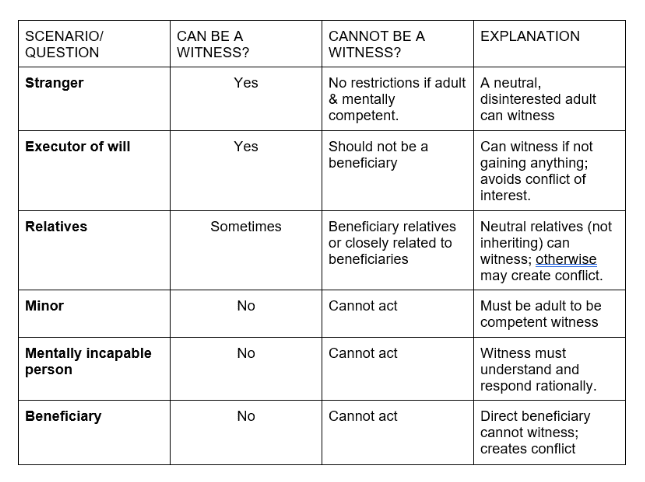
Age and Mental Capacity: Witnesses should be adults of sound mind, capable of understanding what they are witnessing.
Disinterest: Witnesses should not be beneficiaries in the Will. This prevents any conflict of interest or bias.
Presence During Signing: Witnesses must see the testator sign the Will or hear the testator acknowledge the signature. They must sign the Will themselves in the presence of the testator.
Voluntary and Sound Mind of Testator: Witnesses help confirm that the testator signed voluntarily and was mentally fit at the time of signing.
No Need to Know Contents: Witnesses do not need to know the details of the Will; their role is only to verify proper execution.
Legal Importance: Following these requirements ensures the Will is legally valid, reduces chances of disputes, fraud, or coercion, and facilitates smooth probate if the Will goes to court.
PROOF OF EXECUTION UNDER THE INDIAN EVIDENCE ACT
A Will is considered properly executed when it is signed by the testator and attested by witnesses in accordance with the law.
A Will cannot be used as evidence until at least one witness confirms its execution. They testify that the Will was signed voluntarily and that the testator was of sound mind.
Proper proof of execution prevents fraud, forgery, or undue influence, strengthens the Will’s authenticity, and ensures smooth probate proceedings in court.
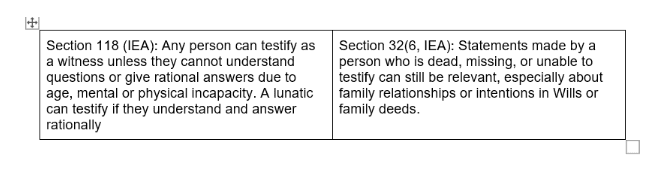
WHO CAN BE A WITNESS
Any adult over 18 years who is mentally capable can act as a witness. The key is that the person should be neutral .they should not gain anything from the Will. Their job is purely to watch the signing, confirm the testator’s free will, and, if required, testify about the execution. Having impartial witnesses ensures the Will is trusted and less likely to face legal challenge
WHO CANNOT BE A WITNESS:
People who are beneficiaries of the Will or close relatives of a beneficiary should avoid acting as witnesses. Their involvement may create a conflict of interest, and a court could view their testimony as biased.
This can weaken the legal strength of the Will, and in some cases, it might even lead to disputes or parts of the Will being contested during probate.
By carefully choosing competent and unbiased witnesses, the testator can make sure their Will stands strong in court, safeguarding their intentions for the future.
ELIGIBILITY OF A WITNESS FOR A WILL
If both the attesting witnesses of the will are dead, how is the execution of the will to be proved?
Sometimes, a Will needs to be proved even if both attesting witnesses have died or are unavailable.
Section 69 of the Indian Evidence Act, 1872 provides a way to do this. The person proving the Will must show two things:
The signature of at least one attesting witness is genuine (handwriting verification).
The testator’s signature is genuine.
Unlike Section 68, no living witness is needed; proving the handwriting of one witness is enough. Courts still evaluate the credibility and reliability of the evidence before accepting the Will, ensuring the document is authentic and the testator’s intentions are respected.
DUTIES OF A WITNESS TO A WILL
To witness execution properly:The witness must see the testator sign the Will, or receive a personal acknowledgment from the testator that the signature is theirs.
To sign in the presence of the testator:The witness must sign the Will in the presence of the testator (though witnesses need not sign in each other's presence).
To be competent and capable:The witness must be of sound mind and capable of understanding what they are attesting.
To testify in court if required:If the Will is disputed, at least one attesting witness must appear before the court to prove execution of the Will (as per the Evidence Act).
RIGHTS OF A WITNESS TO A WILL
Right to refuse to be a witness:No person can be compelled to become a witness to a Will.
Right to protection from liability (if acting honestly):A witness is not liable merely because the Will is later challenged, provided they acted in good faith.
Right to reimbursement of expenses (if summoned):If called to court, the witness is entitled to reasonable expenses as per procedural law.
CASE LAWS:
Ashutosh Samanta (D) by LRs & Ors. v. Sm. Ranjan Bala Dasi & Ors.
● A Will must be strictly proved as per Section 63(c) of the Indian Succession Act, 1925 and Section 68 of the Evidence Act, 1872 at least one attesting witness must be examined to prove due execution and attestation.
● The presumption under Section 90 of the Evidence Act (regarding 30-year-old documents) does not apply to Wills; mere age cannot dispense with proof of attestation.
● If attesting witnesses are dead, unavailable, or deny execution, the propounder can rely on Sections 69 and 71 of the Evidence Act to prove the Will through alternative evidence (such as proof of handwriting/signature).
Rajaram through LRs Smt. Bhagwati Bai & Ors. v. Laxman & Ors.
● The dispute arose from a suit for declaration of title and permanent injunction concerning agricultural land. The plaintiff relied on a Will to claim exclusive ownership after the death of Narayan Singh, who allegedly died issueless.
● The courts below examined whether the Will had been duly proved in accordance with Section 63(c) of the Indian Succession Act, 1925 and Section 68 of the Evidence Act, 1872, particularly focusing on the examination and credibility of attesting witnesses.
● The High Court, in a second appeal under Section 100 CPC, upheld the concurrent findings of the lower courts, emphasizing that proper proof of execution and attestation of the Will is mandatory and no substantial question of law arose for interference.
In conclusion, while a Will serves as a powerful instrument to ensure that a person’s final wishes are respected, its legal validity depends significantly on strict compliance with the prescribed formalities. Attestation is not a mere procedural requirement but a critical safeguard that upholds the authenticity of the document and protects it from future challenges. By ensuring that the Will is properly witnessed, the testator not only strengthens its legal standing but also provides clarity and certainty for their loved ones, ultimately minimizing the risk of disputes and ensuring a smoother transition of assets.
Smriti Mishra
My Legacy Box ("formerly Oiconomos") is an end-to-end solution for personal finance succession management. It simplifies succession planning and management by building on financial hygiene and best practices. Innovative segments like facilitation of one click Will creation which is considered to be one of the most effective tools for inheritance management in the judiciary system, make us stand out. With the help of tech, we make succession management accessible, affordable, and secure for the families of Bharat.
The most effective way to shape your future is by taking action today.
Disclaimer: Please note My Legacy Box ("formerly Oiconomos") is not a law company/firm and does not offer legal advisory. Though materials, software, and services are available to use publicly, they cannot substitute legal counsel by legal practitioners. We do not endorse or solicit the work of any legal counselor.